Launching Satellite Applications on BDB 11.
Two years ago I watched our engineering team spend 20+ weeks building an HRMS application for a University client.
Not twenty weeks to build something novel. Twenty weeks to reconstruct, from scratch, infrastructure that already existed in many other applications SIs had built for multiple other clients. Authentication. Role-based access. Data connectors. Audit trails. The governed definition of what a "staff member" meant in that organisation's specific context.
10 weeks of engineering effort. Zero of it differentiated. All of it was rebuilding foundations we had already built, because we had no mechanism to share them.
I have watched that same twenty weeks get spent a hundred times since. Across industries. Across geographies. Across team sizes. Every time a business needs a new operational application — a risk tracker, a branch performance dashboard, a wealth management tool, a student at-risk monitor — the clock starts again at zero.
Now that stops.
What BDB 11.0 introduces
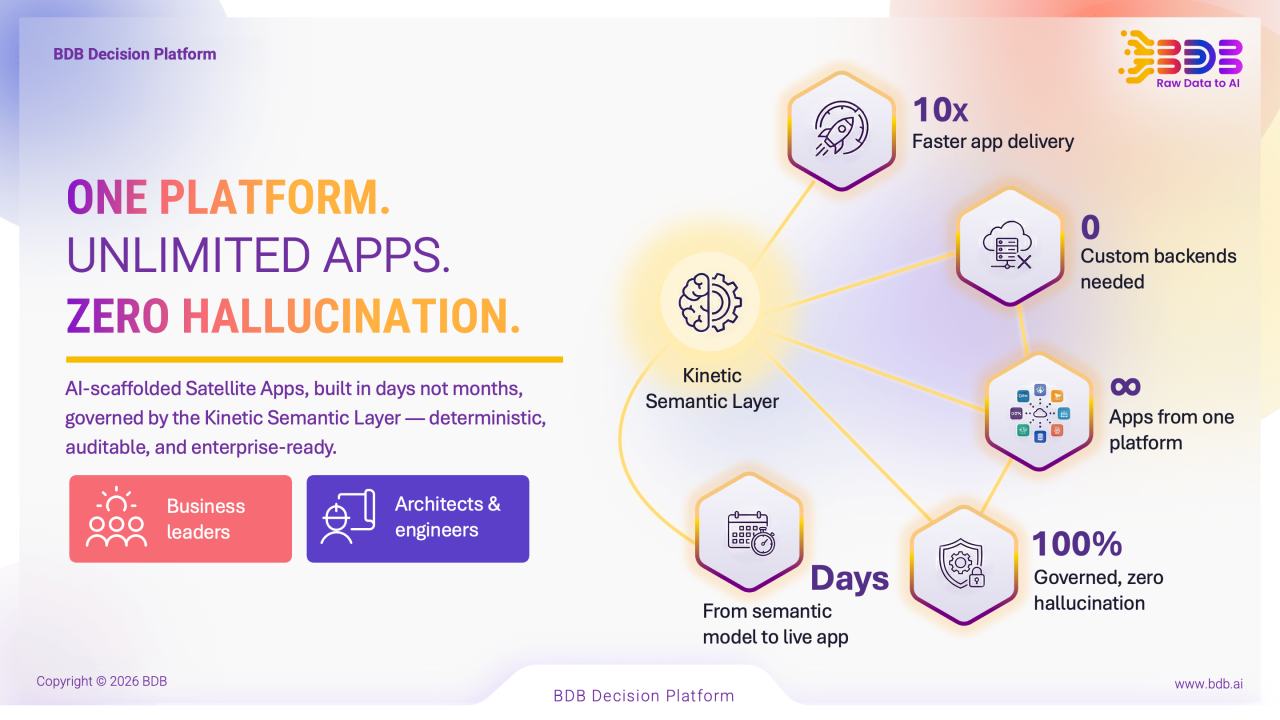
BDB 11.0 ships the Satellite App framework — a new capability built on top of the Kinetic Semantic Layer that changes the fundamental economics of operational application delivery.
The idea is structurally simple. Instead of building each application as a standalone system — its own backend, its own data model, its own definition of what "Customer" or "Revenue" or "Risk" means — you deploy the BDB platform once and scaffold satellite applications on top of it.
Each satellite is thin. It contains only the domain logic specific to its purpose. Everything else — authentication, role management, data connectors, audit trails, governed data definitions, pre-authorised AI actions — is inherited from the platform layer. Once.
The AI coding tools — Claude Code, Cursor AI, OpenAI Codex — read the platform's SDK contracts and conventions and scaffold the satellite. Routes, components, API hooks, semantic query bindings, RBAC wrappers. Generated in hours from contracts that encode twelve years of what enterprise data applications actually need.
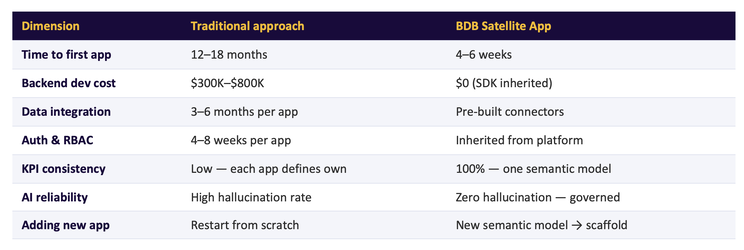
An application that previously took twelve to eighteen months to deliver takes four to six weeks. An application that previously required a dedicated backend team requires configuration and review. An application that previously had its own isolated definition of every business entity now shares one governed definition with every other application in the organisation.
Why the semantic layer is the part that matters most
Most people will focus on the AI scaffolding speed. Ten times faster delivery is a compelling number. It is real. But it is not the most important thing BDB 11.0 delivers.
The most important thing is what sits beneath every satellite: the Kinetic Semantic Layer.
A satellite application built without a governed semantic foundation is fast to deliver and brittle to operate. The AI coding tools scaffold the UI in hours. But when a business user asks the application "what is our revenue this month" and the answer depends on whether "revenue" is defined the same way in the finance system as it is in the CRM as it is in the data warehouse — fast scaffolding has delivered a fast hallucination machine.
BDB's Kinetic Semantic Layer governs this at the foundation level. Every business entity — Customer, Transaction, Product, Account, Risk Score — is defined once, with a canonical plain-language definition, a certified metric library, governed attributes, and explicit relationships. Every satellite application queries that governed layer through a single API. "Revenue" is calculated one way. "Enrolled student" means one thing. "Active subscriber" has one definition regardless of which of the twelve systems in the organisation defined it differently in 2018.
This is what makes BDB satellite applications different from AI-generated applications built on raw data. The speed is the same. The reliability is not.
The Kinetic Semantic Layer is also write-enabled and action-aware. Pre-authorised actions with pre-condition validation mean AI agents within satellite applications can act on business data safely. A compliance hold cannot be placed on a closed account. A credit limit cannot be updated without the required approval chain. A student cannot be marked at-risk without the pastoral lead being notified. These rules are encoded once in the semantic layer and enforced everywhere — across every satellite, every agent, every user query.
What BDB 11.0 ships
The Satellite App framework with AI scaffolding via Claude Code, Cursor AI, and OpenAI Codex.
Platform SDK with eight pre-built hooks:
useSemanticQuery
useSemanticAction
AuthContext
normalizeRows
ProtectedRoute
RoleGuard
useAuditLog
useEntityDefinition
— that give every satellite application enterprise-grade capabilities from day one.
Multi-domain semantic models ready to configure and extend:
BFSI
Telecom
Retail
Healthcare
Education
Automotive
Travel
Manufacturing
Government
Each model contains the canonical business entity definitions, metric libraries, and pre-authorised action frameworks validated across twelve years of enterprise deployments.
- The Kinetic Semantic Layer with write-back support — governed pre-authorised actions with pre-condition validation, not just read-only metric consistency. The first semantic layer in the market that an AI agent can act through safely.
- RBAC inherited at the platform layer, not configured per application. Security by default for every satellite from the moment it is scaffolded.
- Human quality gate built into the delivery model. AI coding tools scaffold. Engineers review. Architects approve. Security signs off. The speed gain is in scaffolding, not in removing the human from consequential decisions.
The Economics
I want to be precise about what ten times faster delivery actually means in practice, because the number is real and I do not want it to sound like marketing.
The worked example: a BFSI Wealth Management application for a private bank. Traditional path: twenty-five weeks, $480,000 estimated. BDB satellite path: four to six weeks, $60,000 estimated. Eight times cheaper. Governance better because semantic definitions are shared and certified. AI reliability guaranteed because the agent queries the semantic layer, not raw tables.
The structural advantage compounds. A five-satellite organisation on BDB runs one platform that gets more valuable with each satellite added. Every new domain model extends the semantic layer rather than creating a new silo. The economics improve with each addition. The complexity does not grow.
Where we are starting
BDB 11.0 can be deployed for clients from next week. If you are already running BDB, your platform layer is in place. Your first satellite can be scoped and started immediately without a new infrastructure engagement, just with an upgradation. SaaS customers can leverage it any time.
For new clients, the entry point is a platform deployment, (20 Core Private Deployment or 8 Core SaaS Tenant) — four to six weeks to configure the Kinetic Semantic Layer for your domain, map your data connectors, and configure your RBAC structure. After that, each satellite application follows in weeks not months.
The verticals where we are deploying first: Travel, Education, Retail and Telecom — where we have the deepest domain semantic models and the most validated pre-authorised action frameworks. Healthcare and BFSI are in active deployment for Q3 26.
Why this matters beyond the feature
I have spent twelve years watching enterprises make the same structural mistake: they invest heavily in data infrastructure and then build operational applications on top of raw data with no governed semantic foundation. The data lake is world-class. The semantic layer is missing. Every application defines its business entities independently. Every AI agent hallucinates because it is reasoning about undefined concepts.
The Satellite App framework on BDB 11.0 is not just a faster way to build applications. It is the correct structural answer to that problem. The governed semantic layer is the prerequisite. The AI scaffolding is the accelerant. The satellite model is the architecture that makes both reusable across every domain an organisation operates in.
The question I keep getting asked is: "How long before AI agents are reliable enough to trust in production?" The answer is not about the LLM. It has never been about the LLM. It is about whether the data the LLM reasons about has a governed meaning attached to it.
BDB 11.0 is our answer to that question. The semantic layer is live. The AI scaffolding is live. The satellite model is live. Build on it.
Avin Jain — Founder & CEO, BDB.ai
avin.jain@bdb.ai · www.bdb.ai
BDB 11.0 is available now for existing clients. New client onboarding for BFSI, Education, and Telecom verticals open from this month. Contact us to scope your first satellite.
Launching Satellite Applications on BDB 11.