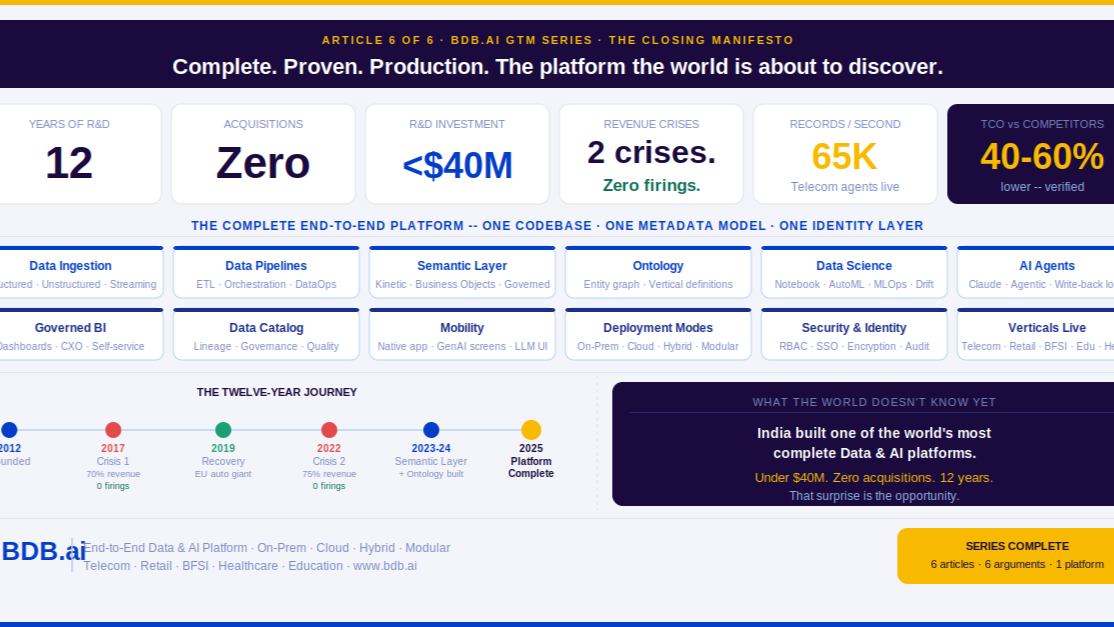
Twelve Years. Two Near-Deaths. Self-Sustenance. And a Platform the World Is About to Discover.
I want to start this final article differently from the previous five.
Not with a statistic. Not with a provocation. With two moments from the last twelve years that very few people know about — and that explain, better than any product comparison, why BDB exists, what it is built on, and why I believe the next chapter will be different from every chapter that came before.
The first moment: 2018
2018
In 2017, BDB was executing on its first significant enterprise contract — a $5 million engagement with a US-based Edu-Tech company. We had built a substantial technical team specifically to deliver this integration. BDB Dashboards embedded, a complex solution designed, a dedicated team of engineers who had spent months learning the customer's environment inside out.
Then, without warning, the client chose to in-source the work. They transferred the lab to India under their own banner. The engagement ended.
70%
That contract represented 70% of BDB's revenue at the time.
I did not fire a single person.
The decision was not noble. It was a conviction. Those engineers knew things about building data platforms that could not be re-hired or re-trained. Losing them would have meant losing the intellectual capacity that was accumulating in our codebase, in our architecture, in our understanding of what an enterprise analytics platform actually needs to do. I chose debt over disbandment. We borrowed $3 million to keep the team together and keep building.
The next two years were the hardest of my professional life. Indian banks would not lend to a technology product company without physical assets as collateral. We operated on thin margins, personal guarantees, and the belief that the platform we were building would eventually reach the customers who needed it.
Then a European automobile giant gave us the contract that changed everything. The work we did for them saved nearly $100 million in their operations. We moved from debt to profit. The team that had survived the 2018-19 crisis delivered one of the most technically impressive deployments in BDB's history.
The second moment: 2022
2022
In February 2022, War in Europe Started.
I am not going to frame this as a business story. It was a human catastrophe. But for BDB, the geopolitical shock had a direct operational consequence: the European automobile client underwent a management change in the wake of supply chain disruption and strategic restructuring. The contract that had rescued us from the 2018-19 crisis ended.
75%
That contract represented 75% of BDB's revenue at the time.
Again, I did not fire a single person.
At that point I had to ask myself honestly: is this perseverance or stubbornness? The answer I came to was this — the platform was real. The work we had done for that automobile company proved it could deliver at enterprise scale. Disbanding the team that had built that would not be a rational cost-cutting decision. It would be destroying the one thing that had taken twelve years to build and could not be rebuilt in two.
So we kept going. Again with debt. Again with the belief that the gap between what BDB had built and what the market understood about BDB would eventually close.
What those two moments taught me about building technology
Most technology companies talk about resilience as a value. For BDB it was a daily operational reality for over a decade. But the lessons I took from those two moments were not about resilience. They were about something more specific.
The first lesson: the people who stayed and kept building through the hard periods are the platform. Not metaphorically — literally. The institutional knowledge, the architectural decisions, the understanding of how enterprise data behaves at scale, the hard-won expertise in telecom KPI modelling, retail semantic definitions, education outcome metrics — that knowledge lives in the 10% of engineers who chose to treat BDB's creative freedom as an opportunity rather than a gap in management. It is not in the code. The code is just the artifact. The knowledge is in the people, accumulated over twelve years of genuine problem-solving for real enterprises with real consequences.
The second lesson: constraints that look like disadvantages in the short term often become the deepest moats in the long term. We could not afford acquisitions, so we built everything from first principles — and the platform is coherent in a way that assembled stacks never are. We could not afford to be cloud-only, so we built for every deployment reality — and now data sovereignty regulation is making that architectural decision worth more than any marketing budget. We could not afford to raise on a promise, so we raised on a proof — and when we do raise, investors will be evaluating a platform that has been tested in production, not a deck.
The companies that survive two near-death revenue events without firing their engineering team either fold within the next 18 months — or they emerge with something that is very difficult to replicate. BDB emerged with the latter.
The honest note on people — and what creative freedom actually requires
There is one more thing I want to say that I have not said publicly before, because I think it is important for anyone building a technology company in India — or anywhere — to hear.
At BDB, we gave engineers something that most companies in this industry do not give: the freedom to think creatively, to propose features, to work on problems that interested them, to treat the platform as a shared intellectual project rather than a task list.
Approximately 10% of our engineers seized that opportunity. They are the ones who built the Platform, Pipelines, Data Science Lab, Visualization Framework, Semantic Layer. The Ontology. The agentic framework. The telecom data model, the implementation playbook that ensures success wherever BDB is deployed. The features that now make BDB genuinely differentiated in the global market.
The other 90% treated that freedom as an absence of direction. They waited for instructions, they got bamboozled with their rising market value. They completed assigned tasks without curiosity. When better-paid opportunities arrived — and they always did, because BDB engineers are exceptionally well-trained — they left, taking their salaries but leaving behind very little of what they could have contributed.
I do not say this with bitterness. I say it with clarity, fear blocks consciousness & doesn't let it rise. Building deep technology requires a specific kind of personality — someone who is unsatisfied by competence, who is driven by the question of what is possible rather than what is required. Those people are rare everywhere. In India, where education systems reward recall over inquiry and where employment markets reward credentials over depth, they are rarer still. The billing fit of 3-5 years engineers by MNCs in India has virtually killed creativity. When these guys rise above in ranks they don't believe in Indian Technology, deep rooted they know that a self-sustaining technology company will not be able to retain top talent as talent will be pushed hard at their homes to find a easy life.
The 10% who stayed and built are the reason this platform exists. They deserve to be acknowledged. And the lesson — for every founder reading this — is that creative freedom is not a substitute for hiring people who are intrinsically driven to use it. This is just the BDB's case and not generic.
I am not talking about the 3rd death point here as it goes beyond the scope of this article, but what I have realised is everyone has to pass through the massive fear zone (inner black hole) to grow & realise their real identity, even if we take innumerable births, the passage waits but it demands 'THAT' kind of devotion and fearlessness. The LAW doesn't change for anyone, it has never changed nor it will.
What five articles of evidence have established
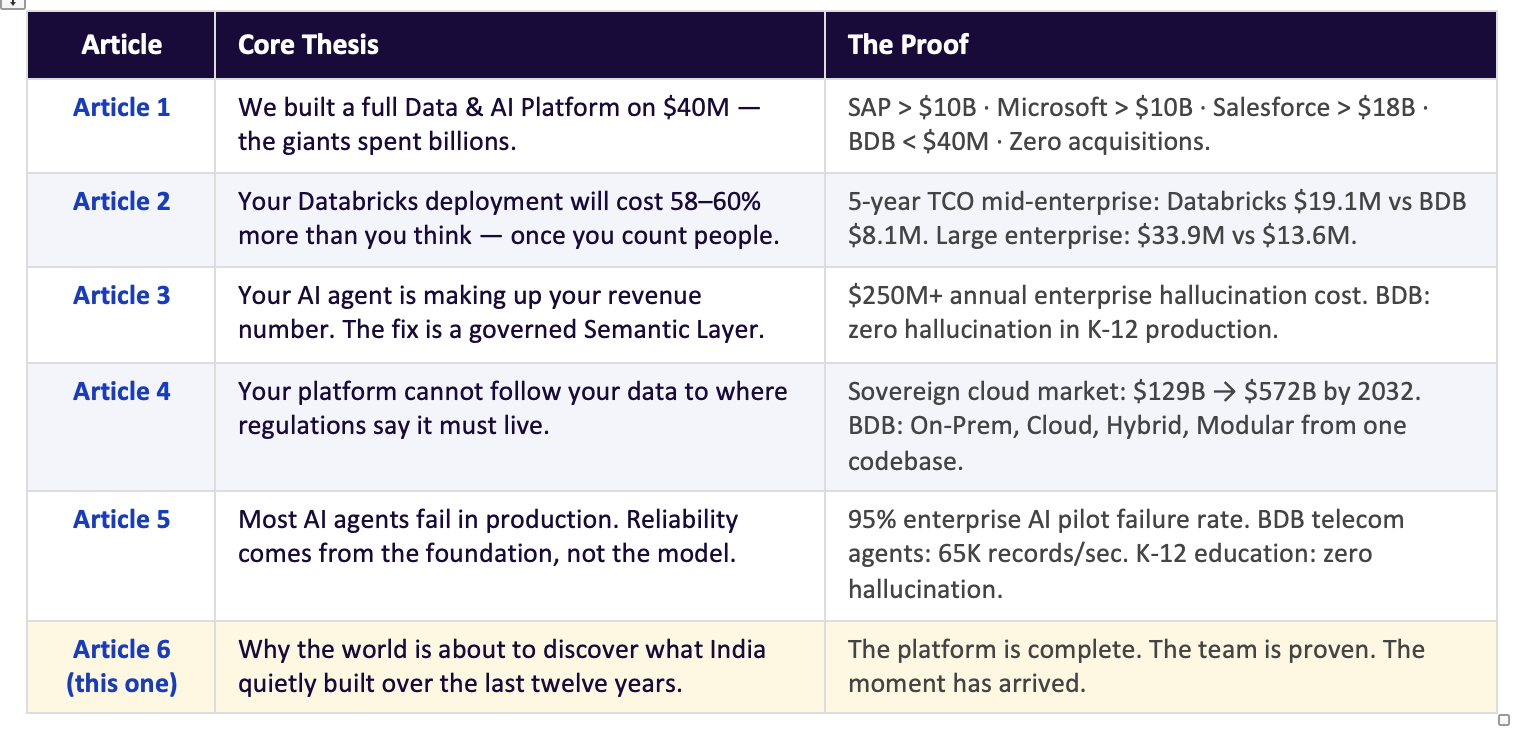
If you have followed this series from Article 1, here is what the evidence adds up to:
These are not claims. They are documented arguments, built from published benchmarks, industry research, regulatory records, and our own verified customer deployments. Every number in this series can be challenged and defended.
Where BDB stands today
The platform is complete. That sentence took twelve years to become true, and I do not use it lightly. Semantic Layer to me was a critical feature which got matured in BDB11.0 version.
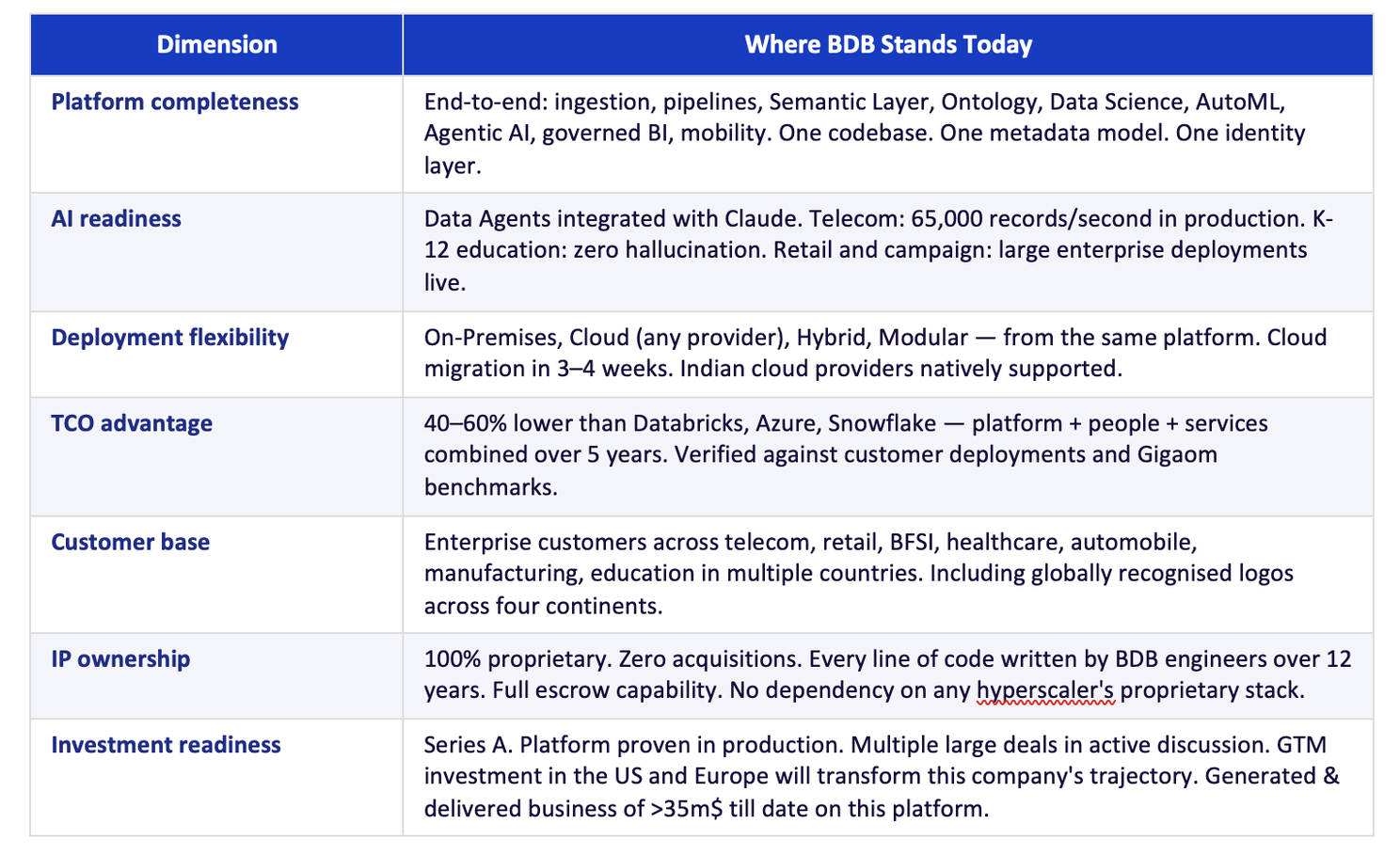
Complete does not mean finished — technology platforms are never finished. It means that BDB now covers the full enterprise data and AI lifecycle without a gap that requires a third-party tool to fill: ingestion, pipelines, semantic layer, ontology, data science, AutoML, agentic AI with Claude integration, governed dashboards, self-service, mobility, and flexible deployment across on-premises, cloud, and hybrid environments.
Here is where we stand across the dimensions that matter for the next phase:
Why BDB is a global alternative on Data Analytics & AI
The deliberate decision to wait until this point before seeking significant external investment was not a consequence of failed fundraising attempts. It was a choice. I did not want to raise investors' money to build the platform. I wanted to raise investors' money to tell the world about it. That distinction matters — to me, and to the investors I want as partners.
We are not raising to prove the concept. We are raising to scale what is already proven. That is a fundamentally different conversation — and one that I am now confident enough to have.
The India question
I want to address something directly that has been implicit throughout this series.
BDB is an India based company. Built in India, by Indian engineers, with Indian sweat and Indian perseverance. We operate in India, USA and middle East, and we have delivered significant results for enterprises across USA, Asia, Africa, the Middle East, and Europe.
The Indian institutional ecosystem — government bodies, large system integrators, technology influencers, enterprise procurement organisations — has, with very few exceptions, ignored BDB entirely. Companies with large marketing budgets and modest technology depth get featured in procurement shortlists and analyst reports. A platform that has quietly built one of the most technically complete data and AI offerings in the world goes unrecognised because it does not have a channel partner programme, a Gartner Magic Quadrant entry, or Investment from a blue chip fund.
The conversations about 'Make in India' in the technology sector are almost entirely about manufacturing and services delivery. The idea that India could build a globally competitive enterprise software platform — not as a services wrapper around someone else's technology, but as genuine intellectual property built from the ground up — remains largely unimaginable to the institutional decision-makers who could accelerate it.
I say this not to seek sympathy. I say it because it is a structural observation that has strategic implications. The global enterprise software market does not know what has been built here. The first CDO or CTO who evaluates BDB without the prior assumption that a world-class platform cannot come from India will find something that surprises them. That surprise is the opportunity. Two CTO in past have believed us and gave us 5m$+ contract and they have done wonders for their companies.
India built one of the world's most complete Data and AI platforms in a decade, with less than $40 million, with no acquisitions, through two near-death revenue events. The world does not know this yet. That is not a weakness. It is the starting position for an extraordinary next chapter.
The next chapter
BDB is in active discussion on multiple large enterprise deals across Hi-Tech Integration, telecom, retail, BFSI, Oil & Gas, healthcare etc.. We are building our global GTM strategy. We are looking for the investment partners and strategic allies who understand what we have built and want to be part of taking it to the market it deserves.
🏢
CDOs & CTOs
If you are a CDO or CTO who has read this series and seen your organisation's challenges reflected in it — I would welcome the conversation. Not a sales call. A genuine exchange about whether BDB's architecture is the right foundation for where your data strategy needs to go.
💼
Investors
If you are an investor who looks at Series A companies and asks not just 'what have they built' but 'how did they build it and what did it cost them' — the BDB story will interest you. Twelve years. Zero acquisitions. Two revenue crises survived without a single firing. A platform that is now complete and production-proven across five verticals on four continents. The conversation starts at avin.jain@bdb.ai.
🤝
System Integrators & Channel Partners
If you are a system integrator or channel partner in the US or Europe who has been looking for a platform that can compete on every dimension that matters to enterprise clients — TCO, AI readiness, deployment flexibility, semantic governance — without the baggage of vendor lock-in or hyperscaler dependency, I want to hear from you.
👨💻
Young Engineers in India
And if you are a young engineer in India who is reading this and wondering whether building something genuinely new is worth the difficulty — the answer, from twelve years of evidence, is yes. It is worth it. But only if you treat the freedom to build as the opportunity it is, not the absence of instruction it might feel like.
This is the sixth and final article in the BDB GTM series. Thank you for following it. The series will remain available as a reference — five technical arguments and one honest account of what it took to be in a position to make them.
The platform is ready. The team is exceptional. The timing is right.
The rest is execution.
Twelve Years. Two Near-Deaths. Self-Sustenance. And a Platform the World Is About to Discover.